Gen Fukuhara | Computational Psychiatry Researcher
NCNP Joint Research | Quantifying Interaction in Japanese Conversation | Developer of Turn Lens
One question: how can the interaction between people in ordinary conversation be measured, quantitatively and reproducibly?
Statement
I am Gen Fukuhara, a researcher in computational psychiatry (CPSY). I have worked on a single question: how can the interaction between people in ordinary conversation be measured, quantitatively and reproducibly?
Since November 2025 I have pursued this as a collaborative researcher at NCNP (National Center of Neurology and Psychiatry, Japan), serving as research lead on a joint study of quantitative indicators of interactional features in Japanese conversation. Working from the Corpus of Everyday Japanese Conversation (CEJC), I defined 19 interactional features across four categories, then validated them in stages: first against the corpus metadata (sex and age), then against Big Five personality scores produced by four LLM raters.
Method matters more to me than novelty. Ridge regression, permutation testing over 5,000 iterations, bootstrap variance analysis over 500 iterations, sensitivity analysis, confound control by entering sex and age as predictors, and baseline conditions designed to falsify my own result. All five Big Five dimensions show a significant association after Holm correction (rfold = 0.254–0.517), with agreeableness highest (A, r = 0.517, corrected p = 0.0020).
The coefficients of determination stay at 0.072–0.182, however. That establishes that associations exist, not that an individual's score can be predicted. Extraversion sits just under the threshold (corrected p = 0.0472) and also depends on the choice of regularization parameter, so the verdict on whether an association exists is held in reserve.
The measurement pipeline is now a tool called Turn Lens. Its development is the subject of an accepted poster at the 13th conference of the Japanese Society for Support of Adults with Developmental Disorders (Kochi, September 2026).
Research: Quantifying Interactional Features
Lead lea × NCNP joint research. Phenomena long described qualitatively in conversation analysis, reorganized into a feature set that can be measured quantitatively and reproducibly over a large corpus.
Pause / gap (PG)
Speech ratio, pause length, response gaps, overlap rate, and variability of silence. Eight are established measures; only the coefficient of variation of pause duration is newly defined here.
Filler use (FU)
Filler occurrence rate and fillers per 100 characters. (Identifiers in the released code keep the FILL_ prefix.)
Sequence organization (SO)
Repair initiation, repair after questions, yes/no responses, and lexical alignment. All five are newly defined here. (Identifiers in the released code keep the IX_ prefix.)
Response typing (RT)
Response types following Japanese final particles, including aizuchi patterns. All three are newly defined here. (Identifiers in the released code keep the RESP_ prefix.)
(10 classical / 9 novel)
(conversation × speaker)
(66 conversations)
(IPIP-NEO-120)
Method
Every step below exists to doubt the result, not to strengthen its appearance.
- Data selection: 140 at-home dyadic conversations from CEJC were expanded into 378 conversation × speaker records; only the 120 records meeting all of ≥80 utterance pairs, ≥2,000 characters and ≥10 post-question pairs were retained (258 excluded).
- Leakage control: Ridge regression (α = 100) evaluated with 5-fold CV using a GroupKFold subject-wise split, guaranteeing that no speaker appears in both training and validation folds. Imputation and standardization are fitted on the training portion of each fold only.
- Confound control: the predictors are the 19 interactional features plus sex and age, 21 variables in total. Demographic attributes enter the main model itself, so every association reported here is an association with those attributes held constant.
- Permutation testing: 5,000 iterations, applied to both the overall model correlation and each individual regression coefficient.
- Multiple comparisons: the five Big Five dimensions are treated as five parallel tests, corrected with the Holm-Bonferroni method.
- Coefficient stability: 500 bootstrap resamples yield the SD and 95% CI of each coefficient. Only features supported by both the permutation test and the bootstrap are counted as "dually supported".
- Disclosure of decision-rule strictness: the bootstrap 95% CI alone identifies 28 features, the permutation test alone 20, and requiring both 18. The range over which the choice of rule changes the answer is stated openly.
- Sensitivity analysis: the regularization parameter was varied across α = 10 / 50 / 100 / 200 / 500. For C, E and A rfold moves by less than 0.04; O declines gradually as α grows (0.421→0.380) while N rises (0.315→0.424). O, C, A and N stay significant across the whole range. Only E fails at α = 10 (pHolm = 0.056), so its significance is explicitly flagged as depending on that choice.
- Cross-validation design comparison: subject-wise split (GroupKFold) is set against ordinary KFold. For O (0.401→0.481), A (0.517→0.538) and C (0.447→0.469), KFold returns a higher r, consistent with optimistic bias from speaker leakage. Every reported figure uses the subject-wise split.
- Falsification baselines: condition 1 (with text) vs. condition 2 (summary only) vs. condition 3 (shuffled text, random seed 42). Under condition 3 all five dimensions lose significance after Holm correction (robs = −0.120 to 0.242, pHolm ≥ 0.287), confirming it works as a negative control.
- Power of the design: N = 120 is the complete set of records meeting the quality criteria, not the product of an a priori power calculation. Power was therefore estimated separately, using the real predictor matrix and speaker grouping: at α = 0.05, power reaches 50% at a population multiple correlation of ρ = 0.349 and 80% at ρ = 0.438 (critical value rcrit = 0.250). Small associations are beyond the reach of this design, and that is stated rather than hidden.
Main Results
Permutation test results for predicting virtual Big Five scores from the interactional features plus sex and age. All five dimensions survive Holm correction (rfold = 0.254–0.517), but the coefficients of determination stay at 0.072–0.182: what is shown is the existence of associations, not predictive accuracy.
The figures below summarize a manuscript that has not been peer reviewed (revision of 30 September 2026). Values and wording may change through submission and review. Please contact me directly about citation or replication. The corpus analysed (CEJC) is licensed and distributed by a third party; no transcript, no derived data and no quoted utterance appears anywhere on this page.
| Big Five dimension | rfold | R²oof | p (corrected) | Sig. |
|---|---|---|---|---|
| A — Agreeableness | 0.517 | 0.126 | 0.0020 | * |
| C — Conscientiousness | 0.447 | 0.182 | 0.0020 | * |
| N — Neuroticism | 0.406 | 0.079 | 0.0030 | * |
| O — Openness | 0.401 | 0.154 | 0.0030 | * |
| E — Extraversion | 0.254 | 0.072 | 0.0472 | * held in reserve |
Association, not accuracy
R²oof stays at 0.072–0.182 and RMSE is only slightly below the SD of the target (for A, RMSE = 0.240 against SD = 0.258). For A and N the fold-mean and concatenated correlations diverge (A: 0.517→0.366; N: 0.406→0.294), indicating a systematic offset between folds. This cannot be used to pin down an individual's score.
Contributing features differ by dimension
18 features were "dually supported" — permutation p < 0.05 and a bootstrap 95% CI excluding zero. Counts range from 2 to 5 per dimension (O: 5, C: 4, A: 4, E: 3, N: 2) and the composition differs by dimension. Pause/gap (PG) features contribute to four of the five (O, C, E, A) but to none of N's; the newly defined sequence-organization and response-typing features contribute in three of five (C, A, N). Six of the 18 are novel features, and for N both are novel sequence-organization measures. Repair initiation (unconditional) and the coefficient of variation of pause length are not dually supported in any dimension.
The negative control worked
When text–speaker pairings are shuffled (condition 3), all five dimensions lose significance after Holm correction (robs = −0.120 to 0.242, pHolm ≥ 0.287). Condition 1 leads by Δr = +0.234 to +0.526 across every dimension, showing the LLM scores are not driven by prompt structure or response bias alone.
Features capture individual differences
13 features correlate significantly with age (overlap rate ρ = 0.500, speech ratio ρ = 0.447, filler occurrence ρ = 0.442), and six show a significant sex difference (speech ratio, three pause measures, filler-bearing utterance rate, lexical overlap). For both attributes the significant associations concentrate in the timing and filler categories.
Turn Lens: A Conversation Measurement Tool
The measurement pipeline, packaged so that a person can run it on their own conversation. Scan, consent, record, visualize. Results are shown only on the user's own device.
For adults with developmental disorders, mismatches in conversational tempo, turn-taking and timing often contribute to interpersonal difficulty, yet what exactly is mismatched remains hard to see from the inside. Existing interaction measures presuppose expert analysis and are not designed for self-review.
Turn Lens addresses that gap. The aim is neither diagnosis nor advice, but to give a person and their conversation partner something concrete to look at together, without blame.
- Case
- Two conversations between the presenter and spouse (June 2 and July 20, 2026, with consent), recorded and analyzed automatically.
- Conv. A
- One speaker held 85% of the floor (85:15); response gaps ran 4.4–4.8× baseline (z = +7.45), prompting the realization of talking too much.
- Conv. B
- Filler rate stood out (z = +5.54); the radar profile changed clearly within the same pair. Overlap rate was 0.000 in both.
- New insight
- High filler use and complete absence of interruption were features the user had not anticipated.
- Scope
- Research use only, not a medical service. Short conversations inflate the numbers.
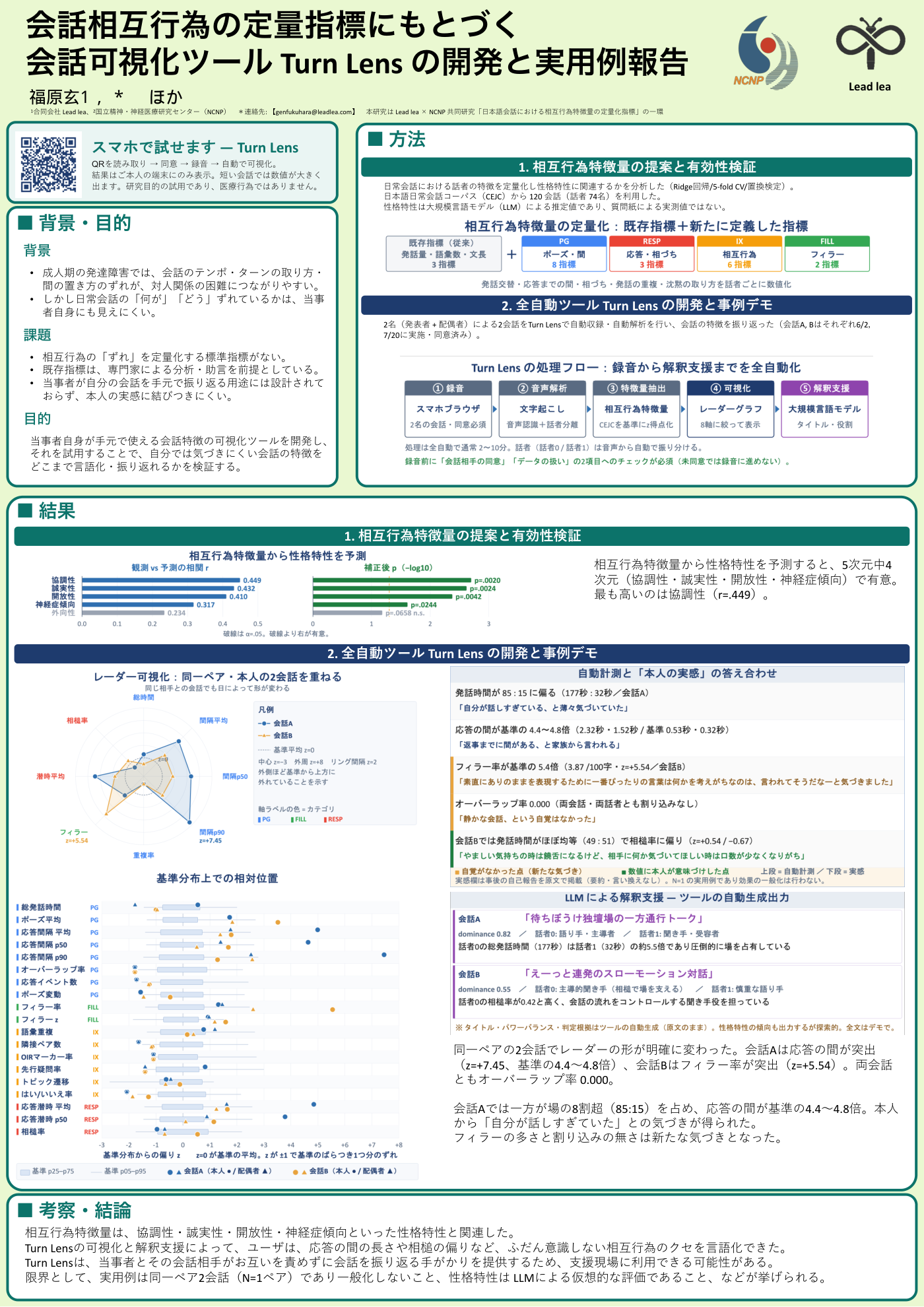
Gen Fukuhara1,* et al. (1Lead lea LLC / NCNP joint research)
The poster reflects the analysis as of August 2026. Its claim of "four of five dimensions significant" was updated to all five once sex and age were entered as predictors in the later revision. The conclusion that agreeableness is highest still holds; the value moved from r = .449 to rfold = 0.517. See the table above for current values (revision of 30 September 2026, not yet peer reviewed). Click to enlarge
Research Interests
Quantifying conversational interaction
Turn-taking, response latency, alignment. Treating qualitatively described phenomena as reproducible numbers.
Computational psychiatry and measurement for adult developmental support
What measurement can a person actually use in a support setting: indicators as material for reflection, not diagnosis.
Reproducible evaluation design
Leakage control, correction for multiple comparisons, sensitivity analysis. Designs that let a result be doubted.
LLMs as measurement instruments, and the validity limits of that use
What are LLMs actually reading? Establishing the usable range via inter-rater agreement, internal consistency, and negative controls.
Limitations
Separating what can be claimed from what cannot. The following limits apply as of now.
- The figures on this page summarize a manuscript that has not been peer reviewed (revision of 30 September 2026) and may change through submission and review.
- Big Five scores are LLM estimates (virtual Big Five), not self-report measures. How far they agree with human personality ratings has not been examined.
- N = 120 is a small sample, insufficient for optimizing the regularization parameter or fitting more complex models, which constrains generalizability. At α = 0.05, 80% power is reached only at a population multiple correlation of ρ = 0.438 or above, so small associations are undetectable here.
- The analysis covers 120 records (66 conversations, 74 speakers) from at-home dyadic conversations in CEJC only. No external validation on a different corpus or under different recording conditions has been carried out, and no claim of generalization across settings or relationships is made.
- That all five dimensions came out significant may indicate a general factor, represented by the amount of speech, contributing in common to several dimensions rather than each dimension having its own association. Speech ratio and the pause measures contribute to three or more dimensions, so discriminability between dimensions needs further examination.
- The coefficient-level tests are an exploratory screen over 21 variables × 5 dimensions with no multiple-comparison correction. Agreement between the permutation test and the bootstrap serves as the decision rule, but that is not theoretically guaranteed as a substitute for correction; the features identified should be treated as hypotheses requiring replication.
- Extraversion sits just under the threshold (corrected p = 0.0472) and fails to reach significance at α = 10, so the verdict on whether an association exists is held in reserve. Its dually supported features are limited to three pause measures; indicators for volume, topic initiation and laughter are missing.
- Confounding is controlled by adding sex and age to the ridge predictors, which cannot remove nonlinear confounding or residual confounding from unmeasured variables. Associations with social attributes such as region of origin (dialect) and occupation have not been examined.
- 25 of 74 speakers appear in two or more conversations (71 records, 59.2% of the total). GroupKFold prevents direct leakage in cross-validation, but the correlation and bootstrap analyses treat multiple records from the same speaker as independent, which can bias standard errors downward. Within-speaker stability (ICC) is future work.
- In every dimension the predictions are compressed: the fitted slope is shallower than y = x, so the predicted range is narrower than the observed range.
- In the baseline check, condition 2 (summary only) was unexpectedly significant across all five dimensions. Cronbach's α there fell to 0.041–0.298 (four-model mean) against α ≥ 0.78 in condition 1, which we read as the LLM leaning heavily on surface quantities when the input is impoverished.
- The Turn Lens case study covers two conversations from a single pair (N = 1 pair) and does not generalize. Research use only, not a medical service.
- This work reports reproducible measurement of interaction, not personality estimation. Each feature is computed from a timestamped utterance table by a stated algorithm with no manual coding step, and each names an identifiable conversational behavior. The Big Five analysis is a means of validating that instrument, and the validation rests on a limited set of criteria: sex, age and the virtual Big Five.
Papers & Presentations
Development and case report of Turn Lens, a conversation visualization tool based on quantitative interaction indicators
13th Conference of the Japanese Society for Support of Adults with Developmental Disorders, Kochi (accepted July 28, 2026)
Conference detailsQuantitative Indicators of Interactional Features in Everyday Japanese Conversation: A Proposal and Its Validation
A systematic proposal and validation of interactional features for a Japanese conversation corpus. The English version runs to 53 pages of main text (4 figures, 5 tables; Appendix A covers sensitivity to the regularization parameter and Appendix B the power of the design) plus 24 pages of supplementary material (S1–S8: data selection, the LLM scoring procedure, the correlation table, full coefficients, inter-model agreement, the three baseline conditions, and the matching strings behind each feature definition). This is a pre-review manuscript. The text, the figures and tables, and the analysis data are not published on this site.
The analysis code and reproduction steps are public. They include the feature definitions, the evaluation design, the scripts that generate every figure and table, a synthetic dataset that runs without the corpus, and a check of the reported values against the code that produced them (59 checks).
Lead lea × NCNP joint research: quantitative indicators of interactional features in Japanese conversation
Approved October 29 and formally contracted November 4, 2025. Research lead: Gen Fukuhara (Lead lea LLC), with collaborators at the NCNP National Institute of Neuroscience.
Background
The research began outside my day job. Years of building and operating systems inform how I design measurable indicators.
2026.09
Revised the manuscript and restructured it into an English version (53 pages of main text plus 24 pages of supplementary material): sex and age now enter the main model as controls, and a cross-validation design comparison and a power estimate were added. All five Big Five dimensions show significant associations (rfold = 0.254–0.517). The framing was also sharpened, from "a proposal of quantitative indicators" to "reproducible measurement of interaction" — the paper presents an instrument. Poster presentation on Turn Lens at the 13th JSSADD conference, Kochi.
2026.07
Completed the first manuscript draft and reproducibility scripts; poster accepted July 28.
2026.02
Appointed Executive Officer and CAIO, Prime AI (Vision Consulting).
2025.11
Became a collaborative researcher at NCNP, leading the joint study on interactional features.
2025.06
Selected for the AWS Japan generative AI implementation program.
2025.03
Launched Kankyo AI®, an emotion-analysis XAI service; core technology filed for patent (JP App. No. 2025-040035, filed 13 March 2025), published as JP 2026-151292 A on 29 September 2026 and under examination. Trademark Reg. No. 6956648.
2024.06
Spoke at AWS Summit Japan 2024 on automating surf-report generation with Amazon Bedrock (80% cost reduction).
2023.03–2025.03
CTO at First Trade Inc., leading healthcare SaaS and generative AI adoption.
Outside the Lab
Alongside research and implementation, there is work I have kept up with my body. It belongs to the same person, so it is listed here.
Forty years of surfing
I teach one-to-one surf lessons in Shonan and Oiso, and have been an authorised HOTLINE wetsuit dealer for over 20 years. Automated surf reports with Amazon Bedrock, presented at AWS Summit Japan 2024, are where this experience met implementation work. Private surf lessons (Japanese) →
Ten years running a French toast food truck
Opened in 2012 and served at more than 740 events before the business was transferred in 2021, with 36 media features. I kept developing recipes without egg or dairy, and have now restarted as an on-site catering service. French toast catering (Japanese) →
A vegan diet and conditioning
I chose a vegan diet out of concern for animal welfare and have kept a self-care practice for over 20 years. The gut-brain axis and conditioning are one of my talk themes. Talk details (Japanese) →
Copywriter and senryu poet (as Kakeru Hagami)
I began working as a copywriter in 2002. My senryu and haiku have won grand prizes (Senryu of SME Consultants 2020; the 12th Haiku on Love), and a short story selected in a TOKYO FM radio-drama contest was published in an anthology by Bungeisha, all before ChatGPT and without generative AI. Wanting to understand how words work led me to pragmatics, which is where my research on measuring conversation began. Words under Constraints (Japanese) →
Get in Touch
I welcome collaboration, data sharing and replication.
Questions about feature definitions or reproducibility scripts are equally welcome.
Gen Fukuhara
CTO, Lead lea LLC / Collaborative Researcher, NCNP / Executive Officer & CAIO, Prime AI
461-5 Kokufuhongo, Oiso-machi, Naka-gun, Kanagawa 259-0111, Japan